Saturday, June 23, 2012

Day 2- American Philosophical Society


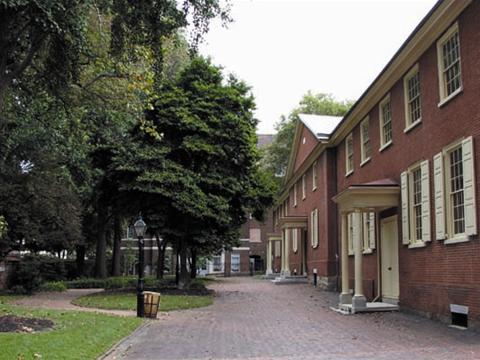
The American Philosophical Society is very concerned with natural philosophy and it was Benjamin Franklin’s attempt at bettering human kind through reasoning.  Franklin was extremely interested in the world around him, looking at the environment around him and using his reasoning to figure out its function.  Benjamin also wrote many papers on his thoughts, observations, and letters over new ideas.


A letter from Benjamin Franklin to "His Excellency John Hancock, Esq."  Look at that signature!!!
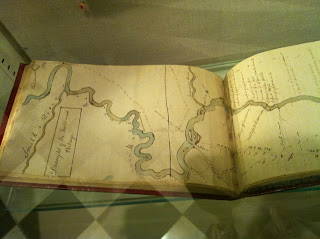


This was one of Lewis and Clark's journals from their expedition.  I actually got to see and read a facsimile (exact replica/copy) of it.  It was incredibly detailed and the descriptions were unreal! Just looking at the picture you can see all of the teeny tiny writing.  The entire journal is the size of my hand and no thicker than a deck of cards.


One of the coolest things that I saw here was an original pamphlet of Thomas Paine’s Common Sense.  This was the pamphlet that helped instill many of the ideas that led to the American Revolution.  Another cool tidbit was that I saw a recollection and record of a treaty that took place.  Even though I have read about and heard about the tactics of rhe Americans to swindle Native’s out of their land, it was still mind boggling to see it in writing. (Picture to be added later)

Day 2- Franklin's Privy and Printshop


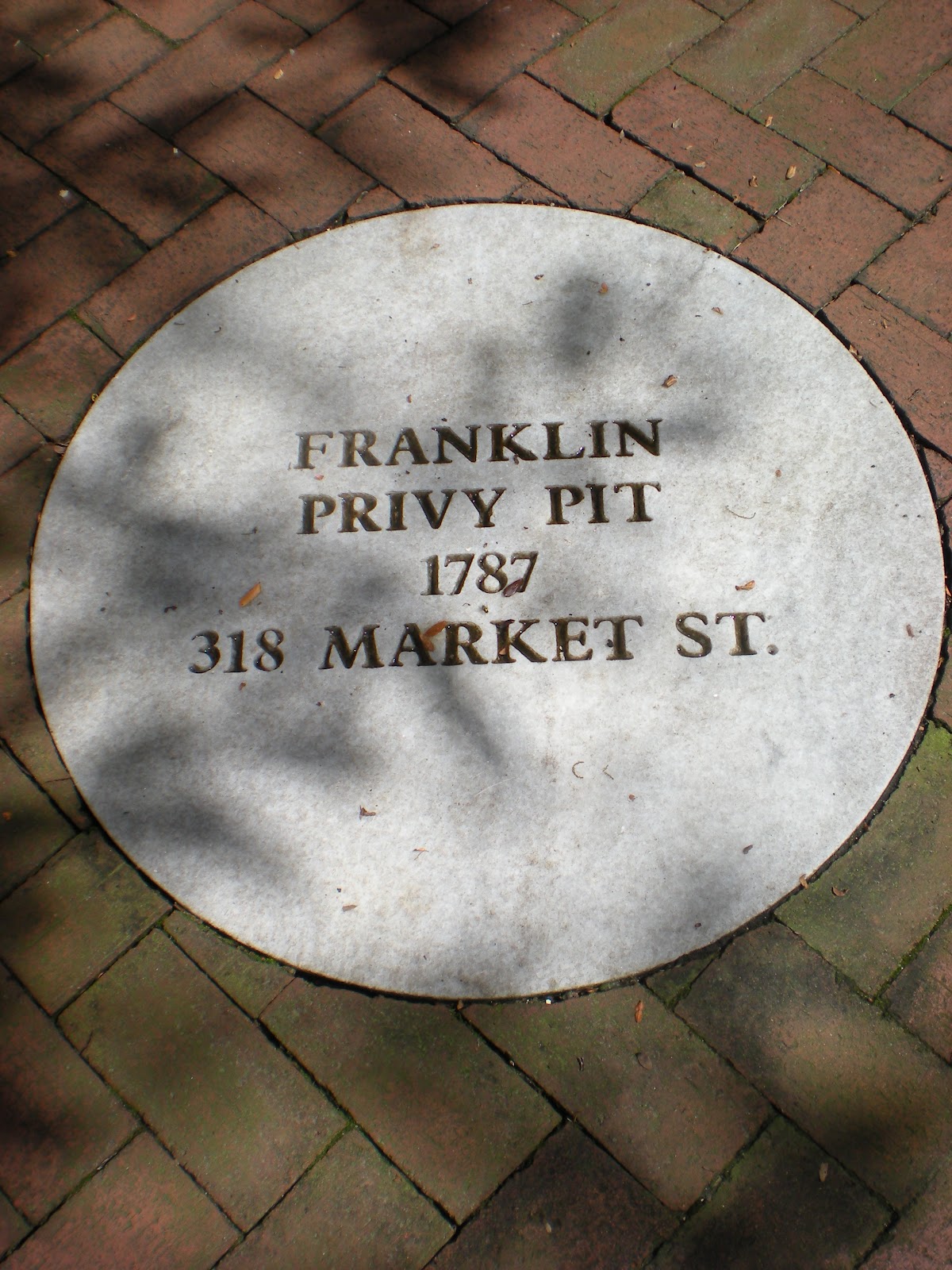
Franklin Court was in the heart of the city in Benjamin Franklin’s day.  There I was able to see where Franklin’s house was, his printing shop, and his privy.

Are you wondering what a privy is? Well a privy was a bathroom.  A privy would be dug about forty feet deep and lined with stone so that it wouldn’t cave in upon itself.  Chamber pots would be emptied into it, but also it was a common trash area.  For example, say I was working one day and I dropped a tea pot on the ground and it shattered. I would sweep up the pieces and go dump them into the privy.


Over time the privy would fill up and be filled in.

As time goes on, all of the human waste disintegrates and all that is left is the garbage.  When archeologists find a privy, they get very excited.  From here, they can tell what daily life was like for whichever family lived there.  For instance, remember that tea pot? Well an archeologist would find the shattered pieces, try reassembling them together, and maybe find a stamp on the bottom telling where it was bought.  From here, they would be able to figure out if we could afford “x amount of money” for a tea pot then we were probably a lower, middle, or upper class family. 

Who knew a privy could tell the future so much?!

As a side note, there was also a capped off water well near the privy? Guess how far away???  Only about 10-20 feet away!  That tells you what people back then did NOT know about disease.


What did Benjamin Franklin do?  Most of us think of Franklin as an inventor? Diplomat? Scientist?  But, did you know that Franklin was actually a printer?

Franklin grew up in Boston, and was apprenticed to his older brother as a printer.  Ben didn’t like that though, and he ran away to Philadelphia, which was a growing city.  He worked as an apprentice in a print shop there, later went to England, and then came back to open up his own print shop. 

For the first 30 years of Ben’s life, he was a “leather apron guy” and always thought of himself as a tradesman.  Franklin retired since most people died of an early age at 42, and then began is life as a scientist, and then eventually as a diplomat.  He ended up living until the age of 84, but still considered himself a printmaker.  While we were here, I was able to see a demonstration of how printmaking was done in Ben Franklin’s time.


Day 2- Quaker Meeting House


What’s a Quaker?  You have probably seen or heard of them, even if you aren’t quite sure.  For example, ever eaten Quaker Oatmeal?

One famous Quaker, was William Penn, the man who was issued a tract of land in the colonies, which we now call Pennsylvania.  Quakers were peaceful people and believed that all men were equal.

         Does that mean they didn’t own slaves?
Nope! Much to my surprise, some Quakers did own slaves.  They were businessmen and slavery was common throughout the colonies.  That did begin to change during the 1800’s in the lead up to the Civil War.  Quakers played a large role in the Underground Railroad and the abolitionist movement of the 1850’s.

Are Quakers still around?

Yes! Quakers are still around and I had to opportunity to go into their meeting house and meet a few.  They look no different than you or I.

How did Quakers worship?

Quakers are very interesting in that they have no dogma in their religion. (Dogma would be considered the rule book to how you worship)  Their meeting house is set up with multiple pews are facing one another in a square pattern.  They have no church leaders, no minister, no preacher. (In fact, their meeting house is very plain inside with no ornamentation at all!)  Instead, they sit for about ten minutes silently and then someone might stand to say something.  From there, people think about their words and then someone might comment back a few minutes later.  In fact, would be completely acceptable for an entire meeting (about an hour) to be silent the entire time.

         Were Quakers liked?

Not entirely.  In the time period, Quakers were often criticized because they did not show proper respect.  If you were walking down the street and met someone of a higher rank or station ( a judge perhaps) it was expected that you would stop, tip you hat, and say good morning.  But, Quakers did not do this since they believed that all were equal.  This was seen as a big NO NO in the time period!


Day 2- Christ Church and Christ Church Burial Ground


Have you ever heard of Christ Church?  How about the Episcopalian Church? Well, Christ Church is the mother church of all Episcopalian churches the United States over. (Episcopalian churches began after the split with the church of England)

When you walk into the church you might realize that you are walking on the people’s tombs.  This was a common English practice which carried over into colonial America.  On the outside of the church are also tombs.  When tombs are on the outside, you are supposed to not walk on them.  BUT, when it comes to graves inside of the church, it is considered good luck to walk upon the dead.  These men who were buried here, wanted to become a literal part of the church when they died.


When was Christ Church’s last service?

Christ Church is still an active church.  They hold services every day as well as being a historic landmark.

Who attended Christ Church?

Some of the people who attended Christ Church might sound very familiar to you: George Washington, Robert Morris, Benjamin Franklin, and Betsy Ross.

Where did they sit?

When you went to Christ Church you actually paid for your seat.  You had your own private pew and the most important towns people (aka the rich) had the pews closest to the pulpit.  Those who were not as rich would sit closer to the back of the church.

How long has Christ Church been around?

                 Christ Church was found in 1695, but the current church was built in  1744.  To put that in perspective, Christ Church has only had TEN                ministers since our country was born in 1776. That means that today I am only teaching the TWELTH generation of Americans!!! (Makes you think!)

I was also able to go and see Christ Church Burial Ground.  It’s very unique because there are lots of gravestones all around, but you can actually read very few.  Why? Well because most of the stones are made of limestone and they have been worn away through time and erosion.  One of the men running the burial ground realized this years ago and actually went around and drew a map of all of the graves that he could still identify. Unfortunately, many of the stones were already in a condition where they couldn't be read, so we do know that certain people were buried there...just not where.

Why are some of the stones two different colors?

One set of stones that I saw was two different colors.  The top was unreadable and the bottom perfect! Why? Well the tombstone had sunk overtime and they pulled them back up.  These tombstones actually belonged to Philip Syng (pronounced sing) and his wife.  Syng was a famous silversmith and it was an inkwell that was used in both the signings of the Declaration of Independence and the Constitution.


Here is a picture I took.  Based on the picture…who is buried here and WHY are there pennies on the tombstone?? (Answer at end of blog)


 Why are some people buried there, when they aren’t from Philadelphia?

Back then, transportation was difficult and transporting dead bodies was just not something you did.  If you died in a city, you were buried there.


Who is all buried at Christ Burial?

There are many people who we know and don’t know buried at the church, but most famously there are four signers of the Declaration of Independence:  Dr. Benjamin Rush, Francis Hopkinson, Joseph Hewes, Benjamin Franklin, and George Ross.


**ANSWER: The tombstone is of Benjamin Franklin.  People leave pennies because of Franklin’s famous saying, “A penny saved, is a penny earned.”

Day 2- President's House


When our country first began and Washington D.C. was getting built, our countries first capital was Philadelphia.  Not too far away from Independence Hall was where President Washington lived.  Today you can go and see where his house was and peek into some excavation archeologist have done to find out more about his home.

One story that people have given about his home is that President Washington had a window and he would open it for an hour once day.  As long as people were polite, they could walk by and talk to him about any concerns or grievances that had.  Do you think our President today would be able to do that?!

Was George Washington nice to his slaves?

This was a question that many students have asked.  I am still finding out more information to fully answer this question, but here’s what I have found out so far.

Washington had a personal manservant (slave) who was his constant companion.  He even rode into battle with Washington and it’s recorded that they were very good friends.

But while Washington was President, he did have 8 slaves attempt to run away and 2 who did successfully.  In his diaries, Washington can be seen lamenting that one of his slaves, Hercules, he had treated “nicely” so he didn’t understand why he had run.

The truth of the matter is….they were still slaves.  

Day 2- Liberty Bell


The Liberty Bell was NEVER rung when they signed the Declaration of Independence, like so many people like to believe.  Instead, the Liberty Bell never got that name until the abolitionist movement.  There is an inscription around the bell.  In the mid 1800’s, abolitionists found this out and nicknamed the bell Liberty Bell.

On this day, we walked…walked…walked…walked…and WALKED all over Philadelphia.  It was a great time…minus the 100 degree heat with 100% humidity.  It was HOT!!! J


Tuesday, June 19, 2012

Day 1- National Constitution Center

This morning I went to the National Constitution Center here in Philadelphia.

 The Constitutional Center was actually commissioned by President Ronald Reagan in the 1980's and its honestly one of the better museums I've ever been to.  It is really interactive and it's full of interesting facts!  In the museum there are interactives for you to learn about important people in American history, you can vote for a 2012 presidential candidate and see whether or not your politics match up with your candidate's, swear your oath in as president, try to answer some of the questions that immigrants answer in the naturalization process, and see whether you could vote in the USA during specific time periods based on who you are.  That's only just a few of the many things that you can do!!


Inside the museum.  It's full of computer and digital interactives.  See the big tall upside down tree in the middle? That's computer screens with people's faces running across them.  If you touch on one of the monitors as the faces whiz by, you can find out all about them and also why they are important! It had people like Jackie Robinson, Sen. Alan Simpson, and Mickey Mouse!


You can also walk around Signer's Hall and interact with life-size statues of the signers of the Constitution.  Here's a picture I took today of the delegates from Pennsylvania:

Do you recognize the guy sitting down?

                                                                                  How about the guy with the peg leg?

Figure it out yet? The one sitting is the one and only Benjamin Franklin and the guy with the peg leg is Gouverner Morris.  A lot of people don't know who he is, but he actually wrote the Preamble to the Constitution and was a very colorful character in American History. (More about him later :-)


The afternoon was spent meeting and listening to Dr. Carol Berkin, who wrote one of the books that I read for this trip.  She was a fantastic speaker! She had wonderful voice, inflection, and a great sense of humor! She knows a TON of information all about these men who came to the Constitutional Convention in 1787.

Here's some of the stuff that I learned from her today:

  • The men who came to the Constitutional Convention were scared! Why? Well, the US had only been a country for four years and they quickly realized that their government, called the Articles of Confederation, wasn't working at all!  France, England, and Spain were looking at the United States (knowing it was about to fall apart) and trying to figure out what parts they were going to take over.
    • REMEMBER: The United States was NOT a powerful country back then. It wasn't a powerful country until after World War II in 1945
  • The states really hated one another.  They viewed each other as competitors and enemies almost, so they really didn't like to work together.
  • When these men all came to the convention, most of them had never heard of one another.  The only two men that anyone knew nationally were George Washington and Benjamin Franklin.  Otherwise, if you were from South Carolina, you really only knew those who were from your state...not New York or Virginia.


  • Many people believe that the signers of the Constitution wanted a democracy (ruling by the people), but they actually feared that.  They thought that it would lead to mob rule.  Instead, only land owning white men could vote, because they had a stake in society.  These men did not believe that a political voice was a birth right, (which is what we have today), but instead they thought it was a privilege given to landowning white men.


  • Which state gave women the right to vote first?  Are you thinking Wyoming because that's what I thought too! But....NOPE!  Actually it was New Jersey.  Women were allowed to vote if they owned property from 1790 to 1807.  This was later repealed (or taken away) and it wasn't until Wyoming territory in 1869 that women were able to vote once again.


  • Finally, what is a famous compromise from the Constitution regarding "unfree persons"? If you're thinking of the 3/5 Compromise you're right! For those of you who don't know, this was a clause that meant that slaves counted as 3/5 of a person towards population counts.  This was also included in Articles of Confederation, so it wasn't new at all (although many people believe that).  BUT, what I did learn today was this.....
    • When the Articles of Confederation was created during the Revolutionary War, the South was AGAINST this clause.  They didn't want to count this at all, because it counted towards requisitions. (The amount that state needed to give to the new American government.) It was the North who suggested and pushed for this clause to go through.
    • When the Constitution was created, the North was AGAINST this clause because it would give more representation to the southern states in the House of Representatives.  The South was for the clause, simply because then they could have more representation.


Are you tired of reading yet? Well....I'll be honest...I haven't even scratched the surface when it comes to new information I learned today. But, I am off to bed so that I can get up early for my walking tour of Philadelphia. Feel free to leave comments or ask questions.  I would be happy to answer them!

Ever wonder how checks and balances work? Watch the video and get a view of how each branch addresses a decision. :-)